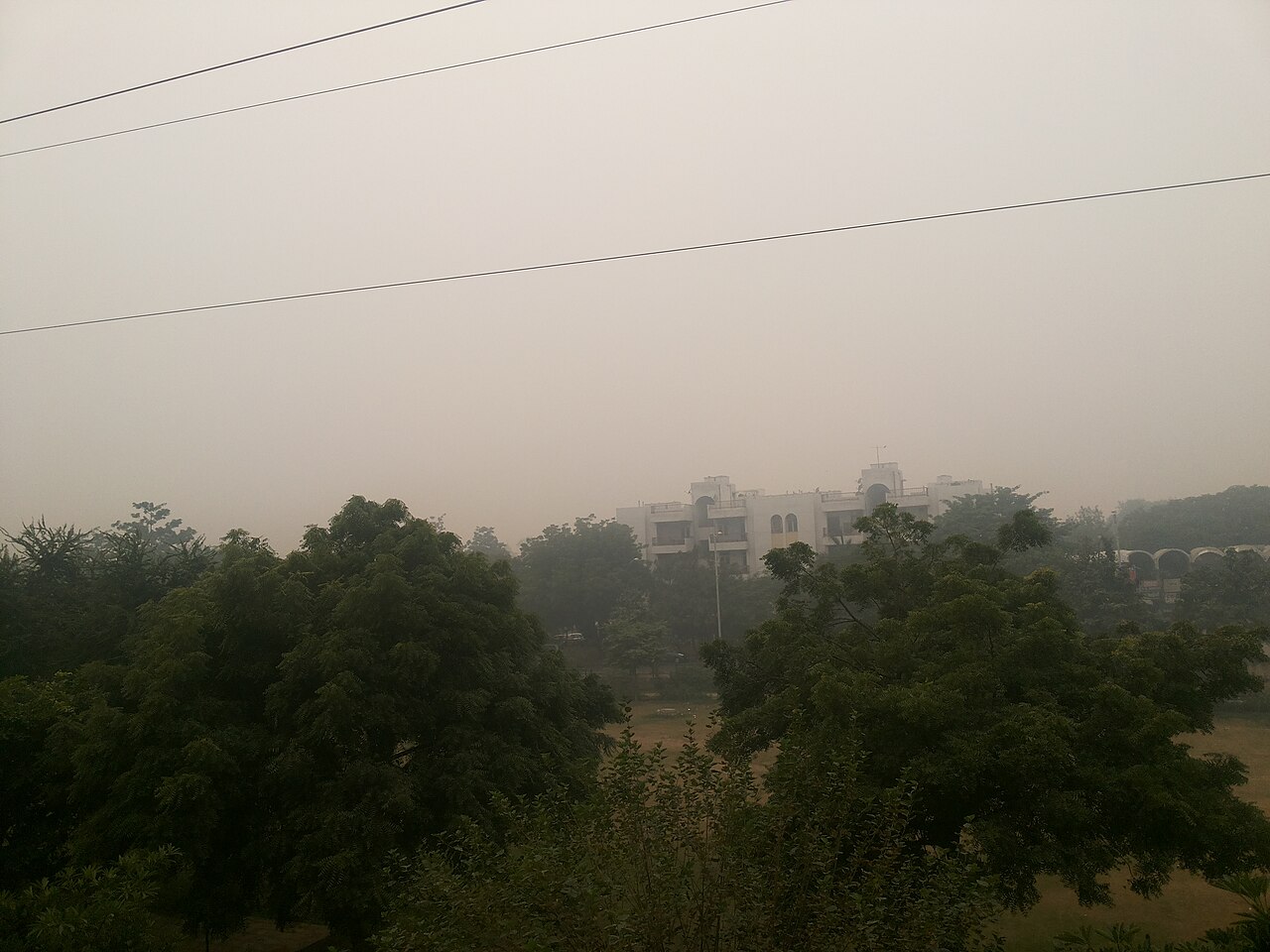
The calendar did what it does every year. Diwali fell on Sunday, November 8; by 7 am on Monday, 15 of Delhi's monitoring stations were reading 'severe' — Sonia Vihar 449, Burari Crossing 445, Vivek Vihar 441, Jahangirpuri 439 — with the citywide average at 366, 'very poor'. Tuesday morning brought a small reprieve, 307 at 7 am with Chandni Chowk still near 400, and the forecasting system run by IITM Pune expects unfavourable weather to keep the region in the very-poor-to-severe range for several more days. The Commission for Air Quality Management had already invoked GRAP Stage III across Delhi-NCR on November 6, and a separate CAQM order dated October 30 caps physical attendance in government and private offices at 50% from November 5 to 20 in Delhi, Gurugram, Faridabad, Ghaziabad, Gautam Buddh Nagar and Sonipat, with outdoor construction and demolition paused across the NCR for the same fortnight. Primary classes have gone hybrid. In other words: for the next few weeks, most of NCR will spend most of its day indoors, at home. For a tenant, that is the whole point of this article.
What the numbers mean, briefly
- The Indian AQI runs 0–500: 201–300 'poor', 301–400 'very poor', 401–450 'severe', above 450 'severe-plus'. GRAP Stage III is tied to the 401–450 band (invoked on forecasts, as this year), Stage IV — school closures, vehicle bans — to 450+.
- PM2.5 is the number that matters for health; the 24-hour Indian standard is 60 µg/m³ and the WHO guideline 15. On Diwali night the 39-station average jumped from 190 to 259 µg/m³ within fifteen minutes of 8 pm.
- Apps that show '1,700' or '2,500' are using the US scale or raw PM readings — alarming, but not comparable to CPCB numbers. Use the CPCB Sameer app or the Delhi government's live page for the official figure.
- Stubble burning is not the main story right now: the Decision Support System put it at about 3% of Delhi's load this week, with local transport around 19%. The smog is mostly local emissions trapped under a winter inversion — which is why it lifts when the wind picks up and comes back when it drops.
AQI is hyper-local — and that is a renter's advantage
A homeowner is stuck with their postcode. A tenant chooses one every eleven months. On the same Monday morning that Sonia Vihar read 449, stations in the south and south-west of the city were 60–100 points lower, and that gap is structural, not luck. North and east Delhi sit downwind of the Yamuna floodplain, the industrial belts of Bawana, Narela and Mundka, and the arterial truck corridors through Anand Vihar and Ghazipur; they also have the least tree cover. The consistently better-performing pockets — not clean, just less bad — tend to be the greener, lower-density parts of south Delhi, the Lutyens zone and its fringes, parts of Dwarka away from the expressway, and the inner sectors of Gurugram and Noida that are not next to a highway or a construction belt. Before you shortlist a flat, pull up the nearest CPCB station's November readings for the last two years. A 50-point difference in annual exposure is a bigger health decision than almost anything else about the flat.
Rule of thumb for NCR: the three things that move a flat's indoor air most are distance from an arterial road or flyover (more than 300 m is the target), distance from active construction (ask the broker; look for cranes), and floor — above the fourth floor you escape most road dust and the worst of the night-time inversion layer.
What to check in a flat before you sign — the smog-season list
- Windows and doors that actually seal: old wooden frames with gaps make a purifier pointless. Run a hand around the frame; if you feel air, budget for weather-strip tape (₹300–500 a window) or negotiate it.
- Cross-ventilation you can control: you want to be able to shut the flat tight on bad mornings and flush it in the afternoon when the AQI dips. Flats with one window wall cannot do either well.
- A room that can be made the 'clean room': a bedroom with a door that closes, no gaps, where one purifier can hold PM2.5 under 50. In a 2BHK that is where the children or elderly parents sleep for the next ten weeks.
- Kitchen exhaust that vents outside, not into the shaft. Indoor cooking is a PM2.5 source on its own; an exhaust that recirculates makes November worse.
- Where the AC outdoor units and the generator sit: a diesel genset exhaust under your window is a daily local pollution event the AQI station never records.
- The building's own construction status: an under-construction tower across the road is a dust source for the full winter and a GRAP violation you cannot do anything about.
- A working balcony door, not just a balcony: the best thing you can do on a 'poor' afternoon is open it for twenty minutes, and the worst thing on a 'severe' morning is not being able to shut it.
Using the season in a rent negotiation
November is the softest month of the NCR rental year — fewer corporate transfers, Diwali spending just done, landlords sitting on empty flats that will not move until January's appraisal cycle. Add the smog and you have leverage that is rarely used. Ask for the landlord to fit or pay for weather-stripping and a kitchen exhaust; a ₹3,000 fix that makes the flat lettable in winter is an easy yes. Ask for a purifier to be included on a two-year lease; a ₹12,000 appliance against ₹5 lakh of rent is a small concession for a tenant who will stay. And ask for a lower deposit: NCR's standard is two to three months, far saner than Bengaluru's, but on a ₹35,000 flat that is still ₹70,000–1,05,000 handed over in the same month you are buying purifiers, N95s and filter refills. A landlord who wants a tenant before Christmas will negotiate on all three.
If you are already in a flat — the next three weeks
- Purifier arithmetic: a unit rated for 350–450 m³/h CADR handles a standard 12×14 ft bedroom with the door shut. Run it on medium continuously rather than on turbo for an hour; replace the HEPA filter every 6–8 months in NCR, not the 12 the box says.
- Ventilate on a schedule, not on instinct: check the CPCB reading at 2–3 pm, when the inversion has usually lifted; if it is below 250, open up for 20–30 minutes, then seal again before dusk.
- The 50% office cap means you are home more — move the desk away from the road-facing window, and if the building has a generator, find out when it runs.
- Tape the gaps: door-bottom draught strips and foam tape on windows cost under ₹1,000 for a 2BHK and improve purifier performance more than buying a second unit.
- Houseplants do not meaningfully clean air at domestic scale; a mop does — PM settles, and wet-mopping twice a week removes what would otherwise be re-suspended.
- N95 for the commute, not for the flat. Indoors, a well-sealed room plus a purifier is the mask.
- Keep the rent agreement handy: GRAP Stage III bans diesel generators above specified sizes in NCR except for emergency and essential uses — if the society is running one for daily backup, that is a complaint to the RWA and, failing that, to the DPCC/HSPCB/UPPCB.
What landlords should take from this
A sealed, exhaust-fitted, purifier-ready flat lets faster and at a better rent every winter from now on — this is NCR's eleventh severe-smog November in a row, and tenants have started asking the questions above. The investments are small: weather-stripping, a proper kitchen chimney vented outdoors, a ban on genset exhaust under residential windows in the society's bylaws. Tenants, in turn, are increasingly willing to sign longer when the flat is a refuge rather than another exposure. The building that advertises its indoor PM2.5 reading will, within a couple of years, be the one that is never vacant in November.
The RentHatke angle
November in NCR is expensive in exactly the month a tenant is also writing the biggest cheque of the year to a landlord. On RentHatke, an RBI-registered lending partner pays the security deposit and you repay it in small monthly instalments by auto-debit, with the full cost in a Key Facts Statement before you sign. On a ₹35,000 flat with a three-month deposit, that is ₹1.05 lakh that stays in your account for the purifier, the filters, the sealed windows — and the move to a better postcode when this lease ends.
Moving within NCR this winter? Check your zero-deposit eligibility on RentHatke in under 2 minutes — no impact on your credit score. (This article summarises publicly reported CPCB/CAQM data and orders as of the morning of November 10, 2026 for general information; readings and restrictions change daily and this is not medical or legal advice. Follow official CPCB, CAQM and health-department advisories.)
Cover image: Hazy post-Diwali November in Delhi by TargetAimShoot, via Wikimedia Commons (CC BY-SA 3.0).


